Etiquetado: epidemiology
Guyenet refutes the idea that sugar causes obesity

Assume that each year you gain an amount of body weight that is directly proportional to the amount of sugar you eat. Or, in other words, if you consume 100 g/d of sugar and you fatten a few kilos, if you eat 50 g/d of sugar, you fatten half that amount.
Suppose you’ve been consuming more and more sugar and you were getting fatter. Your consumption peaked at 110 g/d. Nevertheless, in the last 15 years your consumption has gone down progressively, and today you are eating a little less than you used to: 95 g/d. What is the expected evolution for your body weight? Under the assumption that sugar is making you fatten, your body weight is expected to go on rising, but at a slightly lower rate.
That is what I show in the graph below, created assuming that fattening is directly proportional to sugar intake. The blue curve represents sugar consumption (grams/day); the stars show what the body weight would have been in case we hadn’t changed the sugar consumption trend 15 years ago; the orange curve shows the actual body weight evolution (assuming that instead of consuming more and more sugar, we have progressively and slightly reduced our consumption in the last 15 years, as indicated by the blue curve):
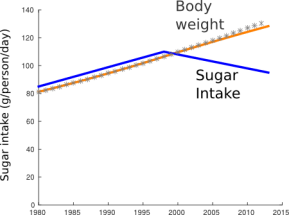
Again, if sugar is fattening, what effect would be expected if our consumption were reduced? We would keep getting fatter, but at a slightly lower rate. That is what the orange curve in the graph above confirmed.
A few days ago (see) Stephan Guyenet, PhD wrote an article trying to refute the idea that sugar is fattening us. In his view, the explanation is simpler than that: we eat too much unhealthy food because we like it. His is just another version of the pseudoscientific energy balance theory.
One of the arguments presented by Guyenet is that added sugar intake has declined between 1999 and 2013, but the percentage of adult obese has not. He says, those facts make «highly unlikely» that sugar is the primary cause of obesity. This is the graph he uses as proof:
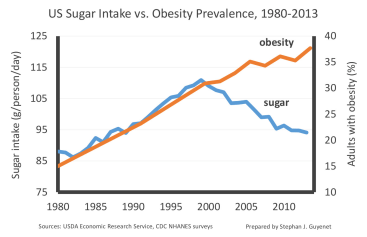
His reasoning is that if consuming 110 g/d of sugar makes us fatten, consuming between 95 and 110 g/d should make us lose weight! Since epidemiological data says we kept getting fatter and fatter, he concludes that sugar is «highly unlikely to be the primary cause of obesity».
Americans have been reining in our sugar intake for more than fourteen years, and not only has it failed to slim us down, it hasn’t even stopped us from gaining additional weight. This suggests that sugar is highly unlikely to be the primary cause of obesity or diabetes in the United States, although again it doesn’t exonerate sugar.
What he is saying is that if hitting your head against the wall ten times produces pain, hitting your head against the wall only nine times shouldn’t be less painful, it should be pleasant. If you realise it is not pleasant, if you realise nine times is still painful, albeit to a lesser extent than doing the same ten times, this suggests that there is no relationship between the hitting against the wall and the pain you suffer. Extremely stupid reasoning.
Moreover: between 1980 and 1999, sugar consumption was in the 85 to 110g/d range and people gained weight. Guyenet says that between 2000 and 2013, when sugar consumption was between 95 and 110 g/d, body weight should have decreased.
On the other hand, note that Guyenet interprets data from the graph as if it were a controlled experiment, when it is just observational data. No controlled experiment was carried out.
Note also that the y-axis for the blue curve in Guyenet’s graph doesn’t begin with zero g/d, and this makes the decrease in sugar intake seem greater than it actually is.
Edit (1/18/2017): there is a second part of this article, providing a more thorough explanation:
If your today’s sugar intake is lower than yesterday’s, do you slim down?
.
Further reading:
 No vuelvo a engordar